

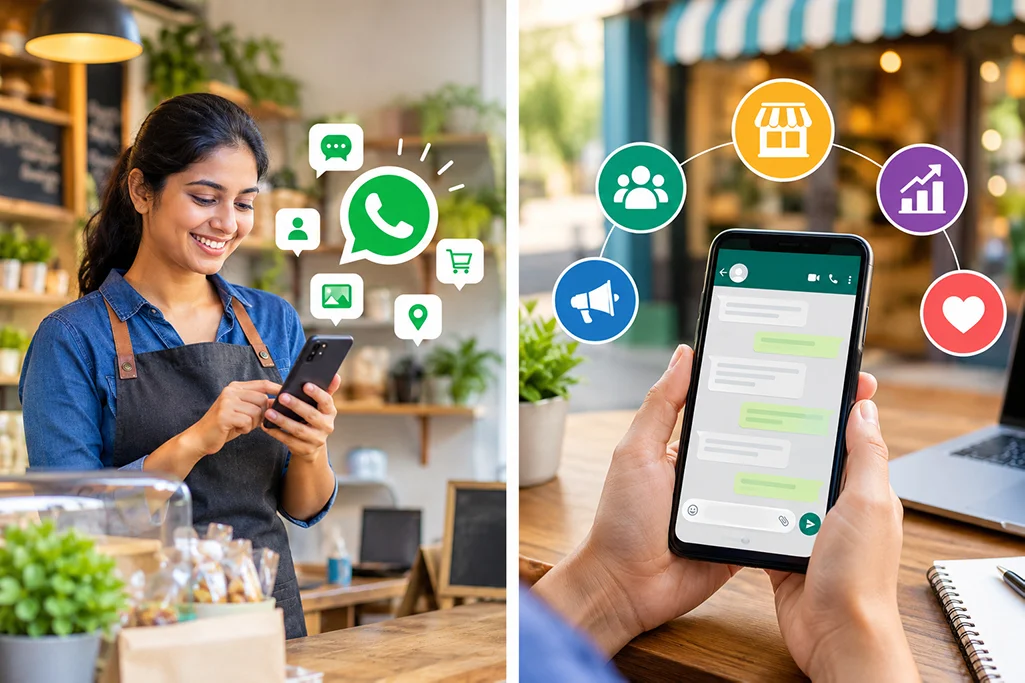
For a local business, growth often starts with something simple: being easy to reach.
A customer may discover your business through Google Search, Instagram or a recommendation from a friend. But when they are ready to ask a question, check a price, book an appointment or place an order, they often want a quick conversation.
That is where WhatsApp can become more than a messaging app. For local businesses it can work as a practical channel for customer communication, lead generation, follow-ups, sales and retention.
Meta says 91% of online adults in India chat with a business weekly based on a 2025 Kantar study.
For a small business that depends on nearby customers this creates an opportunity to turn digital attention into real conversations.
Think about the questions customers ask before making a decision:
If customers have to search through a website or wait for an email reply they may simply move on.
WhatsApp gives them a familiar way to start a conversation.
For local businesses such as salons, clinics, restaurants, coaching centres, boutiques, hotels, repair services and retail stores this can make the customer journey much simpler.
Search → WhatsApp → Conversation → Action
Getting more enquiries is useful. Getting enquiries from people who are genuinely interested is even more useful.
WhatsApp can help businesses capture leads after someone sees a product, service or promotion.
For example:
Instagram post → WhatsApp enquiry → Product discussion → Order
Or:
Google Search → Website → WhatsApp → Appointment booking
This is especially useful for businesses where customers normally want to ask questions before buying.
A local coaching centre could answer course questions. A hotel could share room details. A clinic could help with appointment enquiries. A furniture store could send product photographs and prices.
The important point is that WhatsApp does not replace your other marketing channels. It can connect them.
One of the biggest challenges for small businesses is following up consistently.
Someone asks for a quotation today but does not buy immediately.
Someone enquires about a course but needs a few days to decide.
Someone visits a salon but forgets to book the next appointment.
A useful WhatsApp strategy can keep the conversation moving without making customers feel pressured.
You can use appropriate messages for:
Meta has also introduced customized business messaging capabilities in India for use cases such as appointment reminders, birthday greetings and holiday sale updates.
Local businesses often depend heavily on repeat business.
A customer who visits once may become valuable over time if the business continues to provide a good experience.
WhatsApp can support this relationship.
For example a bakery could send:
“Your favourite brownies are available this weekend. Would you like us to keep a box aside?”
A salon could send:
“It’s been a few weeks since your last appointment. Would you like to book a convenient slot?”
A clothing store could share a new collection that matches a customer’s previous interests.
The difference is important.
Generic promotion:
“20% OFF! BUY NOW!!!”
Useful communication:
“New cotton collections have arrived. We have added a few designs similar to the ones you viewed last time.”
The second approach feels more relevant because it starts with the customer’s needs.
WhatsApp is increasingly being used as part of conversational commerce.
Meta’s recent India retail research reports that retailers using Business Messaging and Click-to-WhatsApp campaigns saw an average 62% increase in leads generated and 22% higher order values in the businesses covered by its analysis. These figures are reported by Meta and should not be treated as a guarantee for every local business.
For a local business the process can be straightforward:
| Customer stage | WhatsApp role |
|---|---|
| Discovery | Introduce the product or service |
| Enquiry | Answer questions |
| Consideration | Share details and options |
| Purchase | Help complete the order |
| After purchase | Provide updates |
| Retention | Encourage repeat visits |
This is one reason WhatsApp marketing can work well when it is connected to an overall digital marketing strategy.
Local businesses can create campaigns around specific locations, events and customer needs.
For example:
Restaurant: Weekend family meal offer
Salon: Festival grooming package
Hotel: Weekend stay package
Gym: New membership batch
Retail store: Local festive collection
Education centre: New admission batch
The message should give customers enough information to understand the offer quickly.
Include:
Avoid sending promotional messages simply because you have a contact list.
The quality of the conversation matters more than the number of messages sent.
Local businesses have one major advantage over large companies: personal relationships.
WhatsApp can strengthen that advantage.
Instead of forcing every customer through a complicated support process you can have a direct conversation.
A customer can send a photograph.
They can explain their requirement.
They can ask a follow-up question.
They can receive a quick answer.
For service businesses this can save time for both sides.
However, speed should not come at the expense of accuracy. Businesses should maintain clear information about prices, availability, timings and policies so that customers receive consistent answers.
WhatsApp Status can be useful for businesses that regularly have something new to show.
You can post:
For example a local bakery could show today’s fresh products.
A photographer could show a recent wedding setup.
A salon could showcase recent work.
A restaurant could highlight today’s special.
The key is variety.
If every Status is an advertisement people may stop paying attention.
The strongest strategy is usually not WhatsApp versus SEO or WhatsApp versus social media.
It is about connecting them.
A local business could build a journey like this:
Google Search
↓
Website
↓
WhatsApp enquiry
↓
Conversation
↓
Booking or purchase
↓
Follow-up
↓
Repeat customer
This is where your website and WhatsApp marketing can support each other.
Businesses looking to build a structured WhatsApp strategy can explore Saikripa Techno Services’ WhatsApp Marketing services for help with planning and implementation.
You can also connect WhatsApp campaigns with your broader digital marketing services so different channels work toward the same business goals.

WhatsApp marketing works best when customers find the communication useful.
Avoid:
Nobody wants their phone constantly filled with promotions.
A restaurant customer and a hotel customer have different needs.
Educational and useful content can also build relationships.
If customers respond but nobody answers quickly the campaign can lose its value.
Always make the next step obvious.
Build your audience through legitimate customer interactions and appropriate consent practices.
Businesses should follow applicable privacy requirements and WhatsApp’s business policies when collecting and communicating with customer information.
You do not need to start with a complicated campaign.
Try this simple framework.
Step 1: Define your goal
Do you want more enquiries, bookings, orders or repeat customers?
Step 2: Identify your audience
Think about your actual local customers rather than trying to reach everyone.
Step 3: Create useful content
Mix promotions with helpful information, updates and relevant content.
Step 4: Give customers an easy next step
Use a clear call to action such as:
“Message us to check availability.”
“Send us your requirement on WhatsApp.”
“Chat with us to book your appointment.”
Step 5: Respond quickly
A campaign can bring the lead but your response helps move the customer forward.
Step 6: Track the results
Record enquiries, qualified leads, bookings, orders and repeat purchases.
Step 7: Improve
Look at which messages generated meaningful conversations and improve the next campaign.
For local businesses, WhatsApp can bring marketing and customer service closer together.
It can help a customer move from “I am interested” to “I want to know more” and eventually to “I want to buy or book.”
But the platform itself is not a growth strategy.
The results depend on what you communicate, who you communicate with, how quickly you respond and how well the experience connects with the rest of your marketing.
For businesses in India especially, the opportunity is significant. Meta reports that more than 60% of people on WhatsApp in India message a business account and its research highlights the scale of messaging and social media use among Indian consumers.
For a local business that wants to build stronger customer relationships, WhatsApp can become a practical bridge between online discovery and real-world business.
